
Real-time AI for critical decisions.
When the scene is chaotic, the clock is seconds, and there's no network — someone still has to decide. We decide with them. Techformic fuses passive multi-modal sensing with deep-learning models that run fully on-site to answer the highest-stakes questions in medicine and airspace security: who to treat first, and what to stop.
- On-site inference
- <3s
- Products, one engine
- 2
- Network dependency
- 0
- Field-evaluated core
- TRL-7
On-site inference
Products, one engine
Network dependency
Field-evaluated core
Two missions, the same shape of problem
Trauma triage and counter-drone defense look nothing alike from the outside. Underneath, they fail for exactly the same four reasons — which is why one engine can solve both.
More inputs than a person can parse
A dozen casualties across a debris field, or nine drone tracks over a perimeter at night.
A window measured in seconds
Triage runs roughly 30 seconds per casualty; a drone crosses a site in under a minute.
No network, no second chance
Austere, jammed, or simply rural. Anything needing a cloud round-trip isn’t a real product for either buyer.
Full accountability
Every decision gets reviewed, clinically or legally. The record isn’t paperwork; it’s part of the product.
Trauma-care decision support for mass-casualty incidents
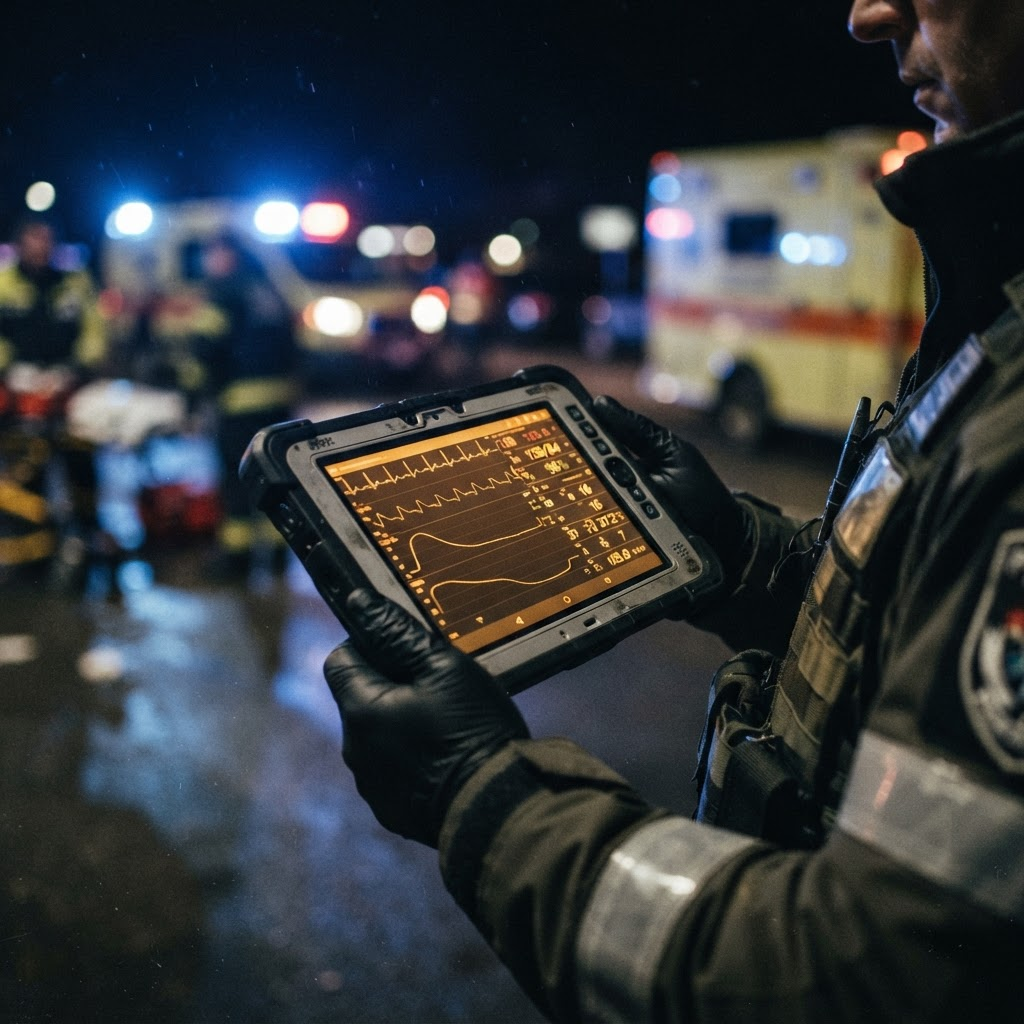
Primary triage from standoff sensors, secondary triage from continuous non-invasive monitoring. One pipeline, from an unsurveyed scene to an ordered, continuously re-sorting queue — running fully on-site, with no network.
Capabilities
- Standoff EO/thermal plus non-invasive contact sensors
- Maps and ranks casualties by urgency, not confidence
- Live queue that keeps re-sorting itself over hours of prolonged field care
- Every output carries a confidence band — the system never assigns a category on its own; the medic does
- Under-triage rate in simulation vs. an ACS Committee on Trauma ceiling of under 5%
- 20–37%
- Human triage accuracy: paramedics ~59%, physicians and nurses ~65%
- ~59–65%
Under-triage rate in simulation vs. an ACS Committee on Trauma ceiling of under 5%
Human triage accuracy: paramedics ~59%, physicians and nurses ~65%
Counter-UAS, built for a buyer nobody else is pricing for
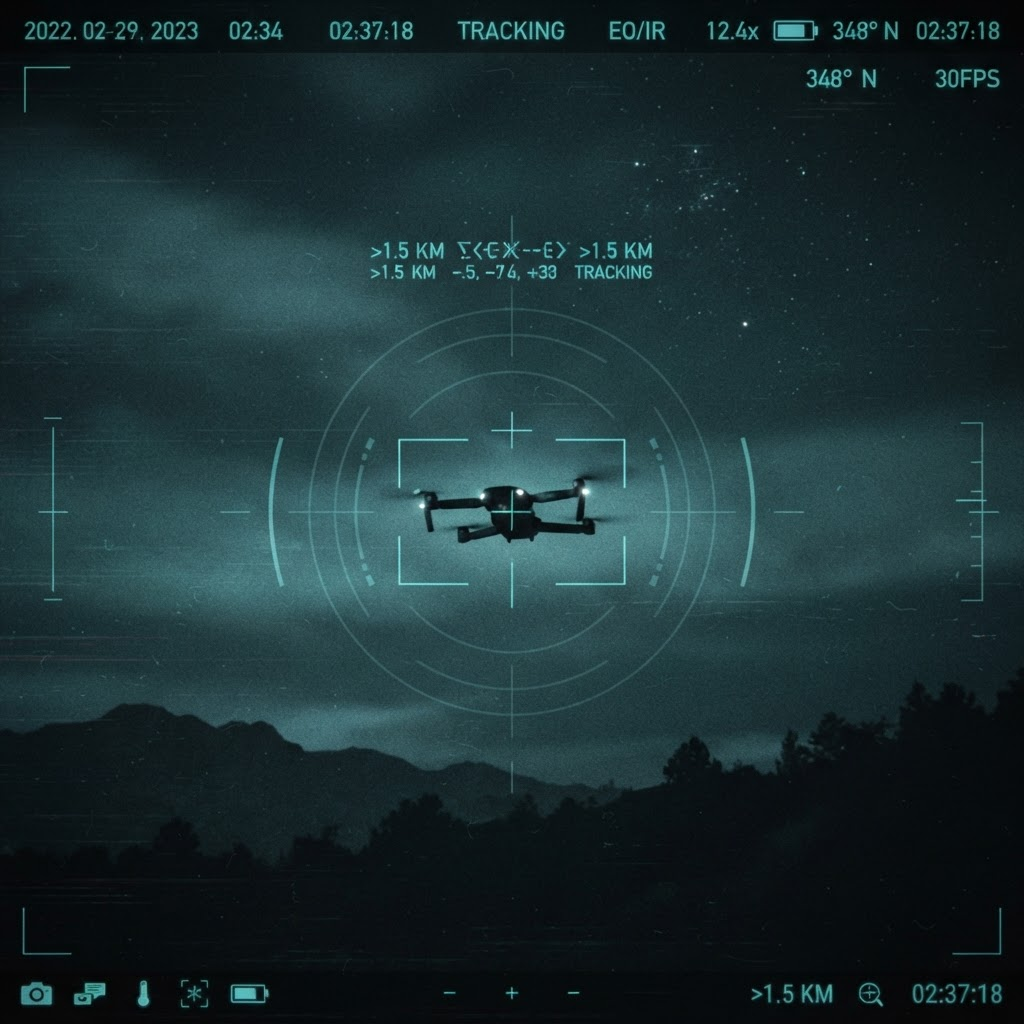
Optical-first, software-defined detection and classification — for a threat that radio-frequency detection can no longer see. AIRSPACE senses drones by seeing and hearing them, not by listening for a radio link they may not have.
Capabilities
- Passive EO, thermal & acoustic node mesh — emits nothing, no spectrum license, no signature
- Detects and classifies drones that defeat RF jamming entirely (fiber-optic, vision-guided)
- Sub-3-second inference from first detection to operator decision, entirely on-site
- Open effector interface — no kill-mechanism lock-in
- Cost of an FPV attack drone vs. the interceptor that stops it
- ~$400 vs. $1M+
- Temporal satellite archive with Chlorophyll Stress Indexing to surface hidden logistics and launch caches
- 10-yr GEOINT
Cost of an FPV attack drone vs. the interceptor that stops it
Temporal satellite archive with Chlorophyll Stress Indexing to surface hidden logistics and launch caches
One engine. Written once, shipped twice.
Both products run on FUSION, a shared edge-AI core. The hard engineering — multi-modal sensor fusion, classification under degraded conditions, sub-3-second on-site inference — is written once and deployed across both mission sets.
The core sensor and edge-compute stack isn't starting from zero. It's TRL-7 and field-evaluated under active sovereign military contracts. The same optical and thermal autonomy that lets AIRSPACE fly through forest canopy, fire, and smoke is the perception stack TRIAGE inherits to scan a mass-casualty scene the same way.
FUSION
Shared edge-AI core
Shared core
Multi-modal sensor fusion · degraded-condition classification · sub-3s on-site inference · low-SWaP edge compute
→ TRIAGE
Casualty perception, ranking, and continuous re-sort.
→ AIRSPACE
Drone detection, classification, and effector cueing.
De-risked under real casualties, real terrain, real time pressure
TRIAGE began under a DARPA call to automate 9-line MEDEVAC decisions on the battlefield. Military field trials are how the core detection and ranking algorithms get de-risked — before that validated core ever carries into civilian EMS.
That heritage is the reason a single company can credibly serve both a county fire department and an allied defense ministry: the perception and inference stack was proven in the hardest environment first.
Three buyers, one procurement story
US counties
Law enforcement, corrections, fire & EMS — sold through certified regional public safety integrators.
Critical infrastructure, airports & trauma systems
Larger sites, higher contract value, across the US and Europe.
Allied defense
India, the Gulf, and NATO frontline states — where casualty care and counter-drone requirements are being written together.
Request a field demo
See TRIAGE and AIRSPACE in action. Our team is ready to demonstrate capabilities tailored to your operational requirements — on your terrain, under your constraints.
Phone
+1 (630) 286-9587Location
Washington, D.C.